The future of communications depends on connectivity and the future is well underway.
To keep up with the demand, the mobile industry introduced 5G – so named because it’s the fifth generation of wireless networking technology. The emergence of 5G technology marked a turning point in the world of telecommunications, with its potential to redefine connectivity, revolutionize industries, and drive global innovation.
Unlike its predecessors, 5G is more than just faster internet speeds—it’s also an entire ecosystem designed to empower technologies like IoT, AI, machine learning, and augmented/virtual reality.
As with past generations, the new 5G cellular communications infrastructure requires an expansive network of transmission equipment, which must perform reliably and efficiently under the harshest conditions. For these reasons, components of these devices must be made of the most durable materials which can be manufactured to the most precise specifications and configurations. Aluminum and the extrusions formed from it meet and exceed these exacting standards.
The transmission equipment itself creates the Radio Access Network (RAN), which connects signals from the core network to the end user. 5G network infrastructure consists of standalone 5G infrastructures, which have their own cloud-native network core that delivers enhanced data, better performance, and all of the many new opportunities made possible by this new standard.
In spite of all of this potential, a 5G device’s antenna ultimately determines how well it performs in actual use. With this in mind, it’s important to consider a few things that ensure the antenna can provide end-users and cell carriers with performance levels that are adequate.
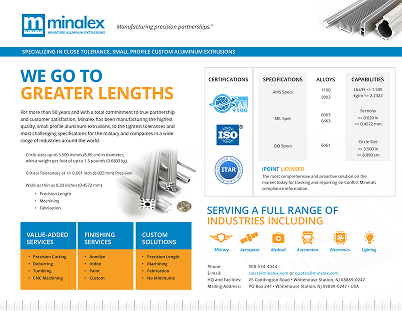
The main hardware components of 5G technology infrastructure include 5G small cell infrastructure, RAN towers and small cell base stations, which are a major feature of 5G networks. They’re designed to blend in with the existing landscape, take up minimal real estate, and are distributed in clusters in device-dense areas to provide continuous connection and complement the macro network that provides wide-area coverage. In these situations, size matters, making miniature aluminum extrusions–like the ones manufactured by Minalex–ideal for their construction.
Miniature aluminum extrusions offer an ideal combination of strength, durability, and lightweight properties, making them highly suitable for components in cell towers, antennae, and base stations. Proof of this type of performance can be found in Minalex manufactured parts performing mission-critical duties in life-saving medical devices and in the environmental extremes beyond earth’s atmosphere.
Their corrosion resistance is especially important in outdoor environments where exposure to extreme weather and temperatures, humidity, and UV radiation can degrade other materials over time. Unlike steel, aluminum doesn’t rust, ensuring long-lasting performance with little or no maintenance required. The ability to design precise, custom extrusions allows for structural components that enhance signal transmission efficiency while reducing overall weight.
Aluminum’s versatility in extrusion allows for the integration of complex shapes, channels, and mounting features directly into the design, which can reduce the need for additional assembly. These characteristics make miniature aluminum extrusions from Minalex a smart choice for modern 5G telecommunications infrastructure, where durability, efficiency, and performance are paramount.
For miniature aluminum extrusions that offer a long life of performance and reliability in 5G infrastructure, call us at (908) 534-4044, or simply click here.